
Pull your real
citation record.
Total citations, h-index, and works count, straight from OpenAlex — the same public record an officer could look up.
Included in your results
See where your work stands in your field.
Field- and year-normalized percentiles from OpenAlex, shown next to your numbers.
See how the benchmark works- How many of your works are in the top 10% and top 1% of their field and year
- How many works were counted, and you can untick any that are not yours
- A comparison with researchers in your subfield, marked as indicative

Real numbers, not estimates.
OpenAlex's own reported figures, nothing modeled or approximated.
Included in this result
- Total citations, h-index, and total works
In the Pro version
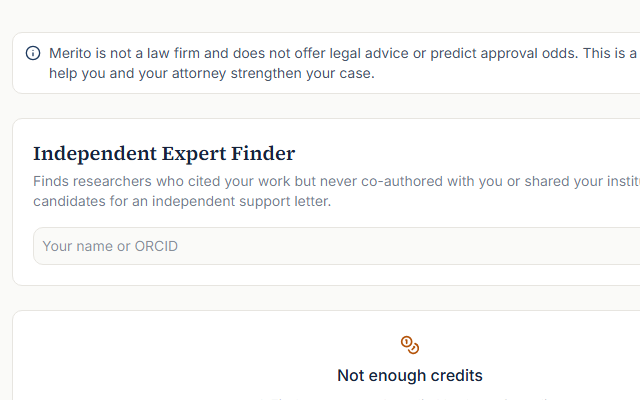
- Which citations are truly independent (not co-authors or your institution)
- Un-conflicted expert letter writer candidates
Your real number isn't what you think it is.
You don't actually know your own count.
Most people estimate their citation count from memory or an old CV line. The real, current figure lives in a bibliometric database, not in your head.
Someone else might share your name.
A common name can pull in another researcher's works and citations entirely by accident, inflating a number that was never really yours.
A wrong number is worse than a missing one.
Citing a citation count that doesn't hold up under an officer's own check reads worse than not citing one at all.
Why a chatbot can't pull your citation record.
A citation count is a fact from a bibliometric database, not something a model can estimate from a conversation.
It has no live connection to a citation database.
A chatbot can only guess at a plausible-sounding number. Merito queries OpenAlex directly and returns the figure it actually reports.
It can't tell you apart from someone with your name.
Author disambiguation needs a structured match against a real works list — a chatbot has no such record to check against.
A wrong number is worse than no number.
A confidently stated but approximate citation count can undercut you with an officer who checks it. This tool never shows a figure it can't source.
How your metrics get pulled.
Enter a name or ORCID iD.
An ORCID iD goes straight to the right person; a name brings up the researchers who match it.
Pick the right person.
Choose the one whose institution and publications you recognize.
See the snapshot.
Total citations, h-index, i10-index and publications, exactly as OpenAlex reports them.
Keep it or share it.
Download the one-page PDF, or share a link to the snapshot.
One public record,
the same one an officer checks.
Total citations, h-index, and works count come straight from OpenAlex's own reported figures — nothing modeled, nothing approximated, nothing an officer couldn't verify themselves.
Field benchmark
Your citations, in the context of your field.
A raw citation count means little without a field and a year: ten citations can be a lot in one field and a few in another. OpenAlex normalizes every work against works of the same field, document type and publication year; Merito shows you the result.
- What it showsThe share of your works in the top 10% and top 1% of their field and year, the median field-weighted impact (1.0 is the world average for that field, type and year), the number of works counted, and text you can adapt for an exhibit.
- Where the data comes fromOpenAlex, a free and open index of scholarly work. Nothing is modeled or estimated by Merito, and every figure can be checked there.
- What it is notThis is a field comparison of citation impact, not an approval prediction. It says nothing about the outcome of any petition.
Median field-weighted impact
2.25
1.0 is the world average for works of the same field, type and year
Reading
Well above average
Works in the top 10% of their field and year
5
of 12 works
Works in the top 1%
1
Counting 12 works of 12
This is a field comparison of citation impact, not an approval prediction.
Questions about the benchmark
How is the percentile calculated?
OpenAlex compares each work with works of the same field, document type and publication year and gives it a citation-normalized percentile. Merito counts how many of your works fall in the top 10% and top 1%, and shows the median field-weighted impact, where 1.0 is the world average for that field, type and year. For the researcher-level comparison it counts researchers in your subfield with at least five works and shows the share below your h-index and citation count; OpenAlex has no first-publication-year field, so that comparison is indicative. When fewer than 20 works or researchers are in a comparison, no share is shown.
Is this an approval prediction?
No. It is a field comparison of citation impact. It does not estimate the chance of any petition outcome, and a high or low figure does not change what an officer decides.
Know your numbers before an officer looks them up.