
Key takeaways
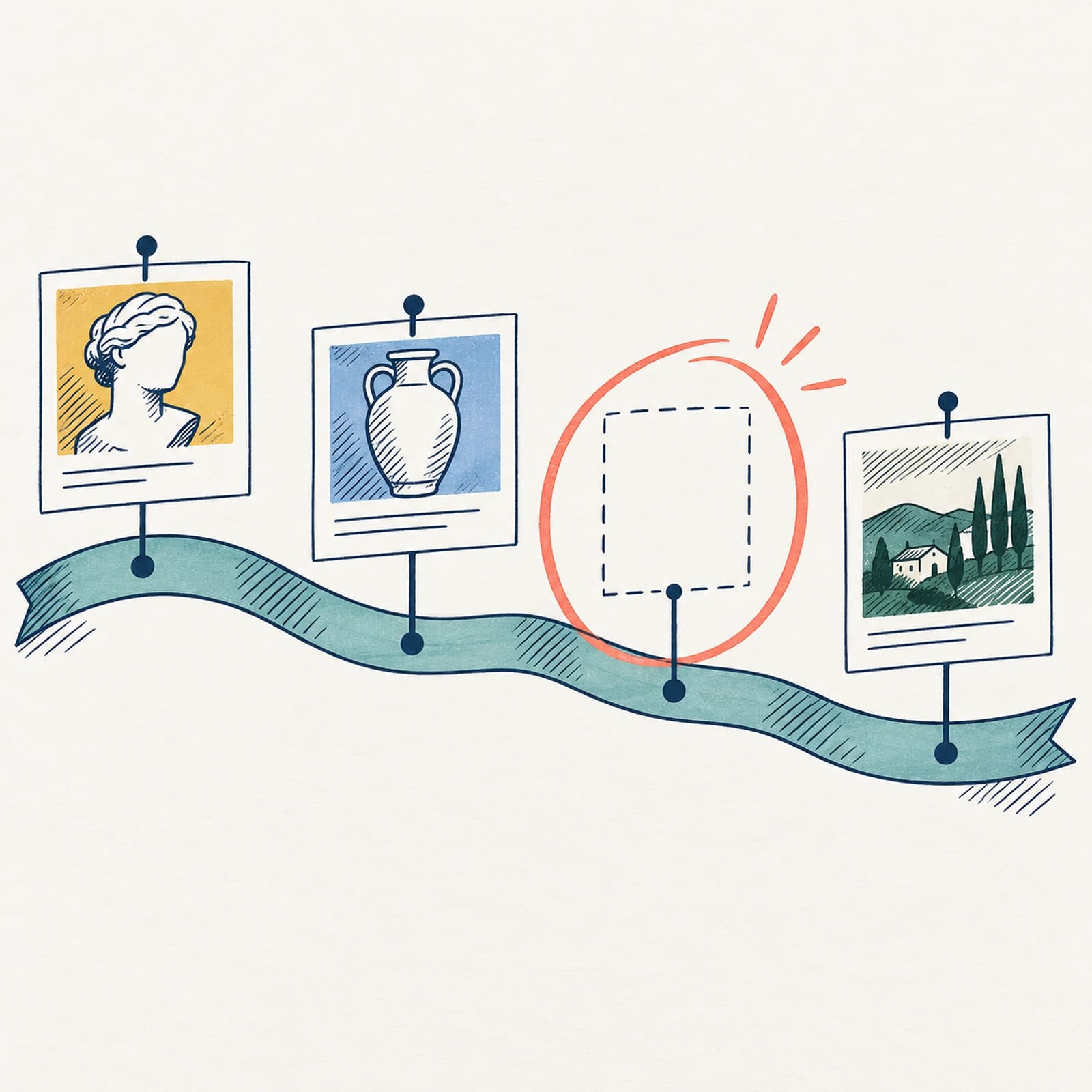
- "Sustained" acclaim is a continuity requirement, not just a quality bar — a record needs to show an ongoing pattern over time, and a numbered exhibit list has no structural way to represent time at all.
- Merito's Case Canvas renders the same evidence four different ways — graph, radar, heatmap, and a dedicated Timeline view — specifically because criterion coverage and chronological coverage are different questions that a single list conflates.
- Evidence Binder's exhibit numbering and Canvas's Timeline read the same underlying Case File, so fixing a chronology gap you spot in one view shows up consistently everywhere else that exhibit is referenced.
An exhibit list is, by design, a flat structure. Exhibit 1 through Exhibit N, each tagged with a label and usually a criterion it supports. It's an excellent tool for the thing it does — making sure nothing referenced in a petition letter is missing from the binder, and giving an officer a fast way to find the document a sentence is citing. What it does not do, and was never built to do, is show a reviewer the shape of a career over time.
That gap matters more for extraordinary-ability petitions than for almost any other filing type, because the underlying legal standard is explicitly about time. EB-1A requires "sustained" national or international acclaim, not a single outstanding year, and O-1A and EB-2 NIW both carry their own versions of the same continuity question. A flat exhibit list, numbered in whatever order the documents were gathered or uploaded, actively obscures the one thing a chronology-aware reviewer is looking for: is this a career with a steady, ongoing pattern of recognition, or a handful of standout achievements separated by long, unexplained silence.
"Sustained" is a continuity requirement, and continuity is invisible in a list
The word "sustained" appears directly in the regulatory language behind EB-1A, and it's treated as a real, separately-assessed element of the final merits determination — not just adjective flourish — in USCIS's own Policy Manual chapter on extraordinary ability. The chapter's evidentiary-standards guidance, applying the "preponderance of the evidence" standard described more generally in Volume 1, Part E, Chapter 6, asks reviewers to weigh the totality of a record — and a record's continuity over time is part of that totality, not a separate box to tick.
A career with acclaim concentrated in one 18-month window five years ago, followed by silence, reads very differently under a continuity-aware review than the same total volume of acclaim spread across five continuous years. Both records might contain the identical number of exhibits. An exhibit list — Exhibit 1 through Exhibit 40, numbered by whatever order they were gathered or by criterion — makes these two records look structurally identical. Nothing about "Exhibit 23: Award certificate" tells a reader whether that award landed in a dense, continuous stretch of recognition or a decade-old outlier standing alone.
Why a criterion view and a chronology view are genuinely different questions
It's tempting to assume that if your evidence is well-distributed across the required criteria, continuity comes along for free. It doesn't, and this is the specific reason Case Canvas ships five distinct views over the same data rather than one. The Graph view shows criteria mapped to evidence — which is exactly the "am I covering enough categories" question. A separate Radar view scores per-criterion strength. A Heatmap crosses evidence kind against criterion, surfacing categories where you have, say, plenty of press mentions but no independent judging record. And a dedicated Timeline view lays the same evidence out chronologically, explicitly flagging multi-month gaps and calling out undated evidence separately rather than silently dropping it from the picture (/help/case-canvas documents all four views plus the version-Compare view that appears once a case has two or more analyzed versions).
The reason these need to be separate views, not one combined score, is that a case can pass the criterion-coverage check and still fail the continuity check, or vice versa. A single "how strong is my evidence" number would blend these two genuinely different failure modes into a result that tells you something is wrong without telling you which of two very different problems to go fix. Reading a case's Graph view alone and assuming the Timeline will look fine by extension is exactly the mistake this separation is meant to prevent.
Exhibit numbering is deterministic — chronology-awareness has to be layered on top
It's worth being precise about what the numbering itself actually does, since it's easy to over-credit it. Evidence Binder assigns exhibit numbers automatically from your existing Case File and flags real, mechanical gaps as it goes — a missing source URL, a missing page reference, a missing issuer or writer's address on a letter — entirely through deterministic code, no AI model call involved, consistent with the "code before AI" approach the underlying packages/audit layer uses across the product (/help/evidence-binder covers the full set of flags, including a distinct "source document removed" bucket for evidence whose original file was later deleted).
That numbering is necessary infrastructure — it's what RFE Studio's and Denial Response's objection cards reference when they cite "the exhibit that answers it," and it's the same numbering a real AAO appeal review would eventually rely on if a case ever reached that stage — but it is not, on its own, a chronology check. Numbering tells you an exhibit exists and is trackable; it says nothing about when the underlying achievement happened relative to everything else in the file. That's precisely why the Timeline view exists as a separate step in Canvas rather than being folded into the Binder's own gap-flagging: a numbered, fully-metadata-complete exhibit can still sit in a six-year gap in your actual timeline, and the Binder has no reason to flag that — dates aren't among the metadata fields it checks for completeness the way source URLs and page references are.
Undated evidence is a chronology gap hiding as a formatting issue
One of the more common real gaps Canvas's Timeline surfaces is evidence with no clear date at all — a press mention with no visible publication date, an award without a stated year, a letter that describes ongoing work without anchoring it to a period. Canvas calls this out as its own category rather than silently placing undated items somewhere arbitrary on the timeline, precisely because undated evidence is a genuine chronology problem, not a cosmetic one: a reviewer applying a continuity standard has no way to credit an achievement toward "sustained" acclaim if they can't tell when it happened. Chasing down a date for evidence that's otherwise strong — going back to the original publication, award announcement, or issuing organization for a specific date — is often a higher-leverage fix than gathering one more piece of evidence from scratch, because it turns evidence that currently can't count toward continuity into evidence that can.
Single points of failure compound the chronology problem
Canvas's Graph view separately marks evidence that backs several criteria — a "Backs several criteria" badge, meaning strengthening that one item lifts every linked criterion, and a challenge to it touches all of them. This intersects with the chronology gap in a specific way: an item backing several criteria, sitting alone in an otherwise sparse stretch of the timeline, is doubly fragile — fragile to a substantive challenge on the merits, and fragile to a continuity read that treats an isolated data point as exactly that, isolated. Reviewing the multi-criteria markers alongside the Timeline view, rather than in isolation, is a more complete way to prioritize which gaps to close first than treating either signal alone as the full picture.
What this looks like in practice
The practical fix isn't a different kind of exhibit list — it's checking a second, genuinely different view of the same evidence before deciding a case is ready. Run Canvas's Timeline after your evidence is otherwise organized in the Binder, not before: look explicitly for gaps of several months or more, note which are adjacent to items that back several criteria, and treat undated evidence as an active to-do (find the real date) rather than a formatting nitpick to clean up later. None of this replaces getting the underlying substance right — a case with perfect chronology and weak evidence is still a weak case — but a case with strong evidence and an unexamined chronology gap is leaving a real, fixable weakness sitting in plain view for whoever reviews it next.
For the legal framework behind why totality-of-the-record matters this much, the Final Merits Determination guide and the deep dive on comparable evidence are both worth reading alongside this piece — continuity and comparable-evidence questions often surface together in nontraditional fields. eb1mentor.com's own writing covers the same ground from the strategy side in The EB-1A Portfolio Timeline: How to Build Stronger Evidence Before You File, and petitioners comparing notes on how they closed their own timeline gaps are a regular presence in Merito's community. If you're ready to see your own case's timeline rendered this way, Case Canvas is part of the Pro plan.
FAQ
Does Case Canvas re-analyze my evidence to build the Timeline?
No. Canvas makes no AI calls of its own — it's a live visualization built directly from your existing Case File, evidence items, and grading. Opening any of its views, including Timeline, never costs credits and never re-runs analysis.
What happens to evidence with no date at all?
Canvas's Timeline view calls out undated evidence as its own distinct category rather than guessing a placement for it or silently omitting it — a deliberate choice so an incomplete date doesn't quietly disappear from the picture.
Is a gap in my timeline automatically disqualifying?
No, and Merito never frames it that way. A timeline gap is a flag worth understanding and, where possible, addressing with real evidence — not a verdict on the case. How much a specific gap matters is a substantive legal question outside what any tool here can answer; this is not legal advice about your specific record.
Do exhibit numbers change if I reorganize my evidence later?
Numbering is generated from your current Case File each time the Binder renders, so it stays internally consistent with what RFE Studio and Denial Response reference — but it's about tracking documents, not about telling you whether they're chronologically distributed. Both are worth checking, but they answer different questions.
This article explains how specific Merito tools organize and visualize evidence — it does not evaluate any individual case and is not legal advice. Merito is not a law firm and does not predict USCIS outcomes.
Merito Editorial Team
Merito editorial team
Merito is not a law firm and does not offer legal advice or predict approval odds. This is a readiness review to help you and your attorney strengthen your case.